
Cart
0
You may also like


If you are trying to build the best supplement routine women can follow from morning to night, don't begin with a list of supplements.
Begin with your biology.
A good morning and evening routine should follow the body's natural daily rhythm. Morning is the time to support nervous-system regulation, healthy waking energy, metabolism and individual hormone needs. Evening is the time to transition toward nervous-system downregulation, recovery and sleep.
Your body at 7:00 AM is not asking for the same thing it needs at 10:00 PM.
In the morning, cortisol normally rises around waking. Your brain transitions toward alertness. Your metabolism moves into daytime activity. Your nervous system prepares you to think, move, make decisions and respond to your environment.
At night, the biological message should begin changing.
Cortisol generally trends lower. The circadian system prepares the body for sleep. Your nervous system needs to become capable of moving away from constant alertness and toward recovery.
This is exactly where I think many supplement routines go wrong.
We take something for anxiety.
Something else for energy.
Something for PMS.
Something for hair loss.
Something for thyroid.
And then something for sleep.
But nobody stops to ask:
Are these things connected?
They are.
And just as importantly:
Does the sequence make sense?
The best supplement routine women can build is one that supports the body's changing needs from morning to evening rather than treating every symptom as a completely separate problem.
For me, the sequence is:
REGULATE → ENERGIZE → SUPPORT → RESTORE

First, regulate the nervous system.
Then support healthy daytime energy and stress resilience.
Then look at thyroid, metabolism and female hormones according to what the individual woman actually needs.
And when evening comes, stop asking the body to perform.
Downshift.
Recover.
Sleep.
This is the philosophy behind the system I created.
I kept seeing women trying one supplement for anxiety, another for PMS, another for sleep, another for energy, another for hair loss and something completely different for thyroid.
But nobody was connecting:
Cortisol.
Nervous system.
Energy.
Thyroid.
Metabolism.
Female hormones.
Sleep.
They were being treated like separate conversations.
They aren't.
Your nervous system communicates with your stress response.
Your brain communicates with your endocrine system.
Thyroid hormones influence metabolism throughout the body.
Reproductive hormone fluctuations can influence mood, sleep and physical symptoms.
Sleep affects metabolic, neurological and emotional regulation.
And stress can influence many of these systems at once.
I wanted to create formulas that complete one another instead of fight against one another.
But I also realized something else:
Sequence matters.
And for me, that sequence begins with the nervous system.
Nervous-system regulation comes first because feeling exhausted does not always mean your body needs more stimulation. You can be depleted and simultaneously feel anxious, wired or unable to switch off.
I see this combination all the time.
“I'm exhausted, but I can't relax.”
“I wake up anxious.”
“I have no energy, but my brain won't stop.”
“I can't think in the morning.”
“I need coffee just to become a person.”
Then evening comes.
You're exhausted.
You finally get into bed.
And suddenly...
Your brain is awake.
Women often describe this as feeling wired and tired.
That phrase doesn't diagnose a cortisol disorder, and it doesn't mean every woman experiencing it has the same underlying cause.
But it tells us something important:
Before automatically adding more stimulation, look at regulation.
Think about a car.
If your foot is already pressing hard on the accelerator, pushing harder isn't necessarily going to make the engine healthier.
This is why nervous-system regulation is the first layer of the supplement routine women can build around their morning physiology.
Cortisol is supposed to rise around waking and is normally higher during the earlier part of the day than late at night. Cortisol is not inherently bad; it is an essential hormone involved in normal waking physiology, metabolism and the stress response.
This is one of the biggest misunderstandings I see in wellness.
Cortisol has somehow become the enemy.
“Lower your cortisol.”
“Block cortisol.”
“Cortisol is making you gain weight.”
But cortisol itself isn't bad.
You need cortisol.
Cortisol is a glucocorticoid hormone involved in metabolism, energy availability, cardiovascular physiology, immune regulation and the body's response to stress.
It also follows a daily rhythm.
One particularly interesting part of this pattern is the cortisol awakening response, or CAR.
Cortisol concentrations typically increase around the period after waking and then generally decline across the day. (PubMed)

I like to think of that morning rise as nature opening the curtains:
Wake up.
We have a day ahead of us.
That is very different from saying chronic stress is healthy.
The goal isn't:
Get cortisol as low as possible.
The better goal is:
Support a healthy rhythm and stress response.
The cortisol awakening response, or CAR, describes a characteristic increase in cortisol associated with waking. It is part of normal HPA-axis and circadian physiology and helps the body transition from sleep into daytime activity.
This is an important distinction because cortisol should not remain at the same level around the clock.
Your body is rhythmic.
Morning and evening are supposed to be different.
And once you understand that, supplement timing starts making much more sense.
Low energy and anxiety can happen at the same time because the systems controlling energy, alertness and the stress response overlap, but they are not identical.
Your stress response involves communication among the brain, autonomic nervous system, HPA axis, sympathetic and parasympathetic nervous systems, catecholamines and metabolic signals.
Sleep matters too.
So does what happened yesterday.
And the day before.
This is why someone can wake up saying:
“I barely have enough energy to get out of bed, but internally I feel like I'm already running.”
And this is where I think we have to be careful with the answer:
More stimulation isn't always what the body is asking for.
But neither is sedation.
Sometimes what we are looking for is:
Calm + clarity.
Not:
Calm + couch.
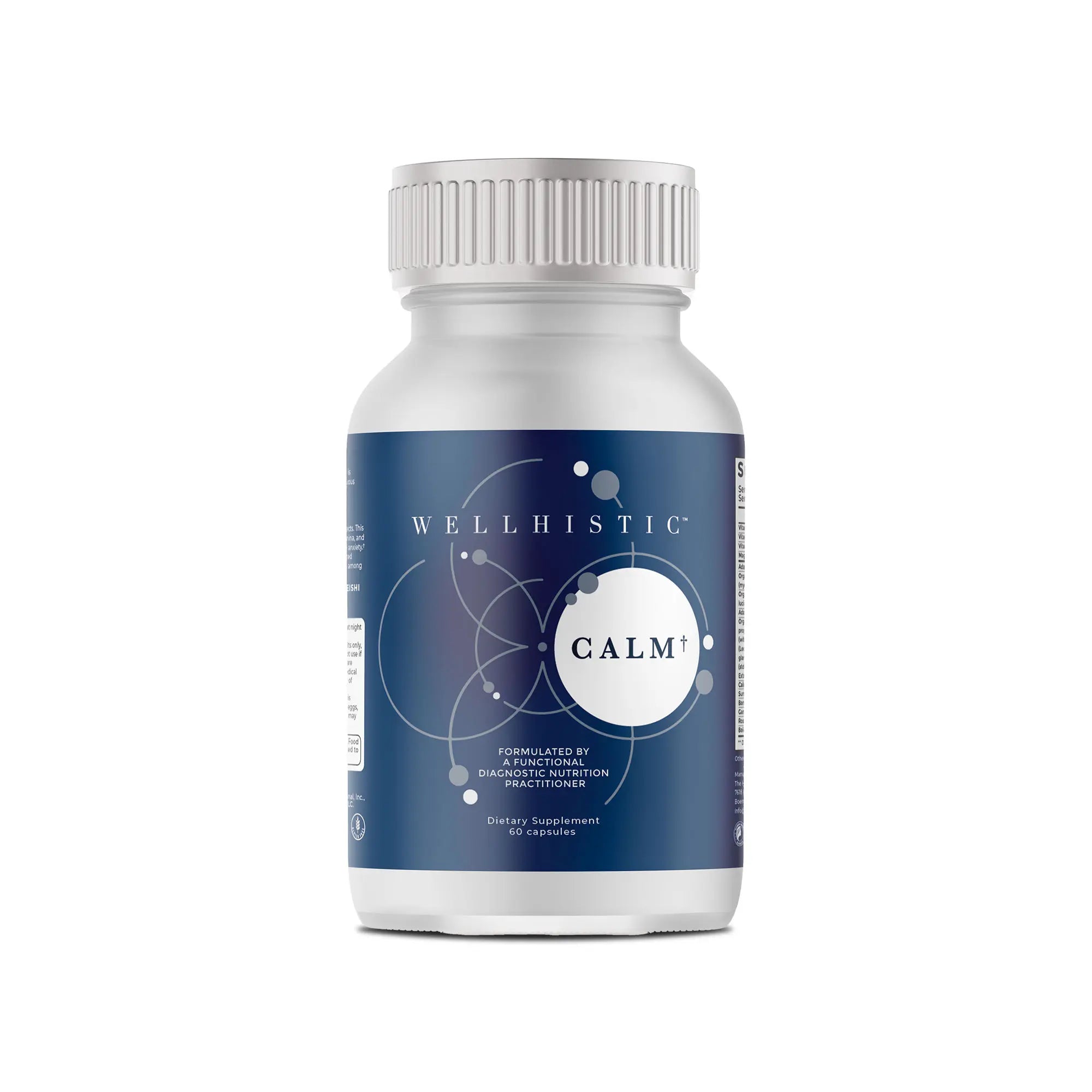
This is exactly why I built CALM.
I needed nervous-system support in the morning when I still had to think, work, drive and function.
I didn't want to turn my brain off.
I wanted to turn down the internal noise so I could actually hear myself think.
I needed calm sharpness.
That is where CALM fits into my system:
The regulation layer.
Not because every woman needs a calming supplement in the morning.
And not because “calm” should mean sedated.
But because sometimes regulation needs to happen before we start demanding more energy from the body.
Then we build.
Healthy morning energy depends on far more than stimulation. Sleep, nutrition, iron status, thyroid function, glucose regulation, hormones, medications, stress and underlying health conditions can all affect how energetic a woman feels.
This is why I don't think the answer to every exhausted morning should be:
More coffee.
Coffee itself isn't necessarily the problem.
But if you cannot function without repeatedly stimulating yourself just to get through the day, it's worth asking:
Why am I so depleted?
Morning fatigue can have many causes.
Poor sleep.
Insufficient nutrition.
Iron deficiency.
Thyroid dysfunction.
Blood sugar problems.
Medication effects.
Hormonal changes.
Chronic stress.
Medical conditions.
Or simply a life that has been asking too much from you for too long.
Persistent fatigue deserves evaluation.
A supplement routine women use should support the body, not hide an unexplained symptom indefinitely.
Once those underlying pieces are being considered, then we can talk about supporting daytime energy and stress resilience rather than simply forcing stimulation.
This is where BOOST fits into my morning system.
I built BOOST around the intersection of brain-adrenal support, stress resilience, energy, mental performance and metabolic function.
For me, it isn't simply an energy pill.
I wanted something for the woman who wasn't just sleepy.
She was depleted.
I generally use 2–4 capsules in the morning with food, depending on individual needs and level of depletion.
The simplest way I describe why I built it is:
Morning coffee energy without the burnout.
Not another whip for an exhausted body.
Energy with resilience.
And once energy enters the conversation, there is another system we cannot ignore.
The thyroid.
Thyroid hormones help regulate metabolism throughout the body, which is why true thyroid dysfunction can affect energy, temperature regulation, hair, skin, cardiovascular function and many other systems.
But this needs nuance.
Hair loss does not automatically mean thyroid disease.
Neither does fatigue.
Neither does difficulty losing weight.
These symptoms have many possible causes.
So significant hair shedding, persistent fatigue or unexplained metabolic changes deserve proper evaluation instead of automatically assuming:
“It's my thyroid.”
Still, thyroid nutrition matters.
Iodine is required for normal thyroid hormone production. (Office of Dietary Supplements)
Selenium-dependent enzymes participate in thyroid hormone metabolism. (Office of Dietary Supplements)
Zinc participates in numerous endocrine and metabolic processes.
So when thyroid-focused nutritional support is appropriate, I think it fits naturally into the daytime portion of a supplement routine women use.
THYROID HAIR & ENERGY came from a combination I kept seeing:
Hair thinning + fatigue + brittle nails + metabolic sluggishness.
Women weren't experiencing these concerns in separate boxes.
They were experiencing all of them in one body.
So I created a formula combining thyroid-relevant micronutrients such as iodine, selenium and zinc with biotin, bamboo-derived silica and botanicals including Gotu Kola, Astragalus and Passionflower.
I use 2 capsules in the morning with breakfast.
Not because every tired woman needs thyroid support.
But because when thyroid nutrition is part of the picture, I wanted it integrated into the larger system rather than treated as another unrelated bottle.
Thyroid disease deserves proper evaluation.
If you take thyroid medication, supplement and medication timing should be discussed with your clinician or pharmacist.
Biotin also deserves special attention because it can interfere with certain laboratory tests, including some thyroid tests. (Office of Dietary Supplements)
Always tell your healthcare professional what supplements you're taking before bloodwork.
Female hormone support should be individualized according to symptoms and hormonal stage. A woman experiencing PMS during her reproductive years does not necessarily need the same support as a woman moving through perimenopause or menopause.
This is where the system branches.
And this distinction matters.
I don't want women automatically taking everything.
I want you asking:
What stage am I actually in?
What symptoms am I actually trying to support?
For the menstrual years, we look at one pathway.
For perimenopause and menopause, we look at another.
PMS can involve both physical and emotional symptoms, including mood changes, irritability, bloating, breast tenderness, cravings, fatigue, headaches and cramping. (Office on Women's Health)
For some women, symptoms are mild.
For others, the days before the period can affect work, relationships and quality of life.
And hormones do not operate independently from the rest of the body.
The menstrual cycle interacts with the brain.
Stress matters.
Sleep matters.
Nutrition matters.
Neurotransmitter signaling matters.
If you want to understand the difference between PMS and a true hormonal imbalance first, read PMS vs Hormonal Imbalance: What’s the Difference?
This is why I believe hormone support should fit into the bigger supplement routine women build rather than being treated as an emergency solution for a few bad days every month.
HORMONE & PMS SUPPORT is my menstrual-years pathway.
It combines botanicals and micronutrients including Chaste Tree Berry, Dong Quai, White Peony, Black Cohosh, Rhodiola, magnesium, vitamin B6, thiamine and zinc.
I designed it around multiple layers of the PMS experience—hormonal fluctuations, physical menstrual symptoms, mood and stress resilience—rather than focusing on one symptom alone.
I generally use 2–4 capsules in the morning depending on symptom severity and individual needs.
For me, the reason it belongs in the system is simple:
A woman's cramps, mood, bloating, stress and menstrual cycle aren't happening in five different bodies.
They are happening in one.
A woman's needs can change significantly during perimenopause and menopause because the hormonal environment itself is changing.
Cycles can become irregular.
Hot flashes may appear.
Night sweats.
Sleep disruption.
Mood changes.
Brain fog.
Changes in libido.
Changes in body composition and metabolic health.
Not every woman experiences all of these symptoms.
And not every symptom in midlife should automatically be blamed on menopause.
But this is a distinct hormonal transition and deserves its own conversation.
The supplement routine women used in their 20s or 30s may not necessarily match what they need during perimenopause or menopause.
MENOPAUSE SUPPORT is the second hormonal pathway in my system.
It combines ingredients including Black Cohosh, Chaste Tree Berry, Dong Quai, Red Clover, Rhodiola, Wild Yam, Milk Thistle, Turmeric, magnesium, vitamin B6 and inositol.
It was designed around the broader menopausal landscape, including support for vasomotor symptoms, emotional resilience, stress, sleep, cognition and metabolic health.
I generally use 2–4 capsules in the morning with food depending on symptom severity and individual needs.
Menopause isn't just a hot flash.
It's a transition happening across an entire woman.
And that's why I wanted a different pathway for it.
HORMONE & PMS SUPPORT and MENOPAUSE SUPPORT are alternatives according to hormonal stage and individual needs. You do not automatically need both.
Your evening routine should be different because your physiology is moving in the opposite direction: away from daytime alertness and toward rest and sleep.
Morning says:
Wake. Focus. Move. Respond.
Evening should begin saying:
Downshift. Recover. Sleep.
Cortisol generally declines across the day.
Melatonin secretion is closely linked to circadian timing and darkness. (NCCIH)
The nervous system also needs to become capable of moving away from constant vigilance.
But this is where many women get stuck.
They work.
Take care of everyone.
Answer messages.
Clean.
Scroll.
Think about tomorrow.
Finally get into bed.
And then ask:
“Why can't I sleep?”
Your body may be physically exhausted.
But your nervous system hasn't necessarily received the message that the day is over.
This is why an evening supplement routine women use should not begin and end with a sleep capsule.
The entire evening environment matters.
A good evening routine should reduce signals that promote alertness and strengthen the behavioral and environmental cues associated with sleep.
That can include:
Keeping a reasonably consistent sleep and wake time.
Reducing bright light as bedtime approaches.
Keeping the bedroom dark, quiet and comfortable.
Being mindful of late-day caffeine.
Giving your brain some transition time between work and bed.
Reducing stimulation close to sleep.
Creating a repetitive nighttime routine. (CDC)
These things sound simple.
But supplements cannot completely compensate for a body receiving the message:
Stay awake. Stay alert. Keep going.
Sometimes the first nighttime intervention is not another capsule.
It's giving the body permission to recognize:
The day is finished.
Potentially, yes. A calming supplement does not necessarily need to be synonymous with a sleep supplement, and the desired effect may be different depending on the time of day.
This is something interesting I've seen with CALM.
I originally cared deeply about the morning experience:
Calm + sharp.
But many people also tell me they like CALM in the evening paired with Sleep Bliss.
And that makes sense within the philosophy of the system.
In the morning:
Regulation helps you function.
At night:
Regulation helps you stop functioning.
Same nervous system.
Different goal.
CALM remains the regulation piece.
Sleep is the next layer.
There is no universal nighttime supplement every woman needs. Sleep support should be chosen according to the actual sleep problem while also considering circadian habits, caffeine, stress, medications and underlying medical conditions.
Sleep is not simply being unconscious.
Sleep participates in memory, emotional regulation, immune function, metabolic health, neurological function and physical recovery.
And this is why sleep became the final piece of my system.
Not because I think every woman needs a sleep supplement.
But because a complete morning and evening routine should eventually answer one important question:
Can your body actually transition out of the day?
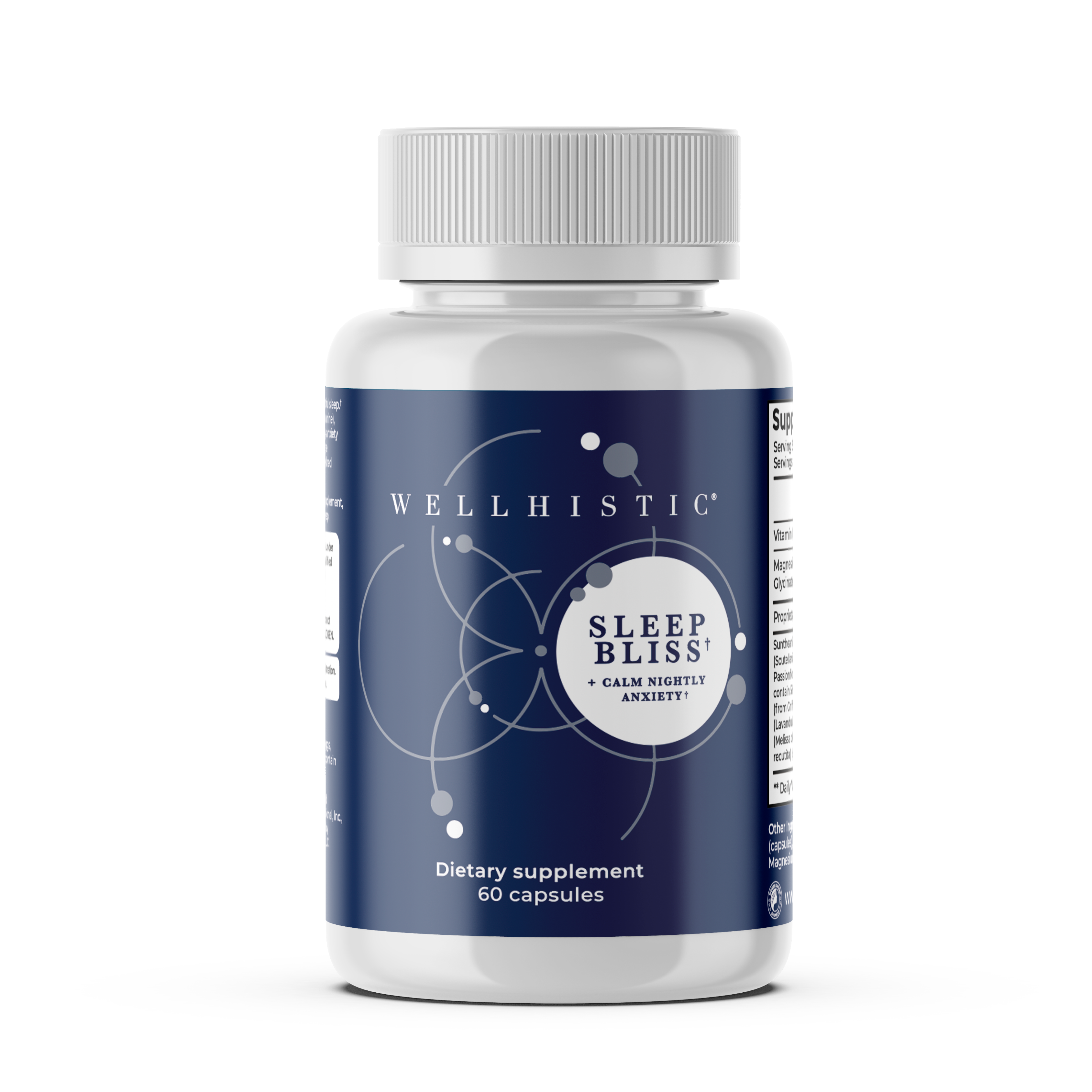
SLEEP BLISS is my targeted nighttime sleep-support formula.
I generally use 2–4 capsules at night depending on individual need.
For women who need both layers, CALM can be paired with Sleep Bliss in the evening.
The distinction is important:
CALM → nervous-system regulation.
SLEEP BLISS → targeted sleep support.
I didn't want the entire system to depend on forcing the body to sleep at the end of a day spent ignoring everything that came before it.
I wanted the whole day to make sense.
You do not need every formula below.
Think of this as a framework showing where different types of support can fit.
| Time | What Are We Supporting? | Where My Formulas Fit |
|---|---|---|
| Morning | Nervous-system regulation + calm focus | CALM |
| Morning with food | Energy + stress resilience + metabolic support | BOOST — 2–4 capsules |
| Morning with breakfast | Thyroid nutrition + hair + energy + metabolism | THYROID HAIR & ENERGY — 2 capsules |
| Morning | Menstrual/PMS support when appropriate | HORMONE & PMS SUPPORT — 2–4 capsules |
| OR Morning | Perimenopause/menopause support when appropriate | MENOPAUSE SUPPORT — 2–4 capsules |
| Evening | Nervous-system downshift when needed | CALM |
| Night | Targeted sleep support | SLEEP BLISS — 2–4 capsules |

The table is not a prescription to take everything.
It's a map.
Your symptoms and needs determine which roads you actually travel.
No. More supplements do not automatically mean better results.
Before building a daily supplement routine women can actually sustain, ask:
What am I trying to support?
Am I waking anxious?
Am I waking depleted?
Is my sleep actually the problem?
Am I experiencing significant hair loss or fatigue that needs evaluation?
Are my symptoms primarily connected to my menstrual cycle?
Am I entering perimenopause or menopause?
Could a nutrient deficiency be contributing?
Could a medication be involved?
Could this be something that needs medical evaluation rather than another supplement?
That last question matters.
Supplements should support your health.
They should not become a way of ignoring what your body is trying to tell you.
The best supplement routine women can follow is individualized and works with the body's natural morning and evening rhythms.
Morning support may focus on nervous-system regulation, appropriate energy, metabolism and individual hormone needs. Evening support should transition toward nervous-system downregulation and sleep.
There is no universal list of supplements every woman needs.
It depends on what the supplement is designed to support.
Supplements associated with daytime energy, metabolism or certain nutritional goals may fit naturally into the morning, while products specifically intended for relaxation or sleep generally belong later in the day.
Medication timing and individual ingredients can change this recommendation.
There is no universal morning supplement stack for every woman.
A morning routine may include targeted nutritional support for deficiencies, nervous-system regulation, energy, thyroid nutrition, metabolism or reproductive hormones depending on the woman's individual needs.
Nighttime supplements should match the actual problem being addressed.
Some women may benefit from targeted nervous-system or sleep support, while others need to address caffeine timing, circadian disruption, stress, medication effects or an underlying sleep disorder.
Yes. Cortisol normally follows a circadian rhythm and is generally higher around the morning waking period than late at night.
That is why the goal should not automatically be to suppress cortisol as much as possible.
Timing and regulation matter.
The cortisol awakening response is the increase in cortisol associated with the period after waking.
It is part of normal HPA-axis and circadian physiology and helps prepare the body for daytime activity.
No. Cortisol is not supposed to be at its lowest in the morning.
Healthy cortisol physiology includes a daily rhythm, with higher concentrations around the earlier portion of the day and lower levels toward nighttime.
Some can, depending on the ingredients, dose and individual response.
Calming support does not automatically mean sedation.
For some women, the desired daytime outcome is nervous-system regulation while maintaining mental clarity and normal function.
Because exhaustion does not always mean the body needs more stimulation.
If fatigue occurs alongside anxiety, feeling wired or difficulty switching off, looking at nervous-system and stress-response regulation can make more sense than automatically adding another stimulant.
Start by identifying why the fatigue is happening rather than simply covering it with stimulation.
Sleep, iron status, nutrition, thyroid function, glucose regulation, medications, hormones, chronic stress and medical conditions can all contribute.
Then build support according to what the body actually needs.
It depends on the formula.
Some nutritional and botanical approaches are designed for consistent use throughout the menstrual cycle rather than only being taken when PMS begins.
Severe mood symptoms, abnormal bleeding or significant menstrual pain deserve medical evaluation.
They address different hormonal stages.
PMS occurs in relation to the menstrual cycle during the reproductive years, while perimenopause and menopause involve a changing ovarian hormone environment and a different set of potential symptoms.
Support should reflect the woman's actual hormonal stage and symptoms.
It depends on the supplement and whether the woman takes thyroid medication.
Prescription thyroid hormones have specific administration requirements, and some supplements or minerals may need to be separated from medication.
Always follow medication instructions and individualized professional guidance.
No.
Sleep supplements can be useful for some women, but chronic sleep problems should also prompt questions about circadian timing, caffeine, stress, medications, hormonal changes and underlying sleep or medical conditions.
I don't think women need another drawer overflowing with supplements.
I think we need to understand why we're taking them.
Your body has rhythm.
Morning and evening are different.
Cortisol isn't automatically bad.
Calm doesn't automatically mean sleepy.
Fatigue doesn't automatically mean you need more stimulation.
Hair loss doesn't automatically mean thyroid disease.
PMS isn't disconnected from your brain and nervous system.
Menopause isn't just hot flashes.
And sleep doesn't begin the second your head touches the pillow.
Everything communicates.
That is why I created Wellhistic as a system.
I wanted formulas that could complete one another rather than fight against one another.
And I wanted the sequence to make sense.
REGULATE → ENERGIZE → SUPPORT → RESTORE
Start with the nervous system.
Then support daytime energy.
Look at thyroid and metabolism when appropriate.
Support female hormones according to the woman's actual hormonal stage.
And when evening arrives, stop asking the body to perform.
Downshift.
Regulate.
Sleep.
Because ultimately, the best supplement routine women can build isn't the one with the most bottles.
It's the one that understands what the body is trying to do from the moment you wake up until the moment you sleep.
TO YOUR INVISIBLE BATTLES AND UNSEEN STRENGTH.
Carola Le-Wriedt
Founder, Wellhistic & The Holistic Detox
These statements have not been evaluated by the Food and Drug Administration. These products are not intended to diagnose, treat, cure or prevent any disease.
This article is for educational purposes only and is not intended to diagnose, treat, cure or prevent disease. Supplements are not appropriate for everyone and may interact with medications or medical conditions. Pregnancy, breastfeeding, thyroid disease, hormone-sensitive conditions, prescription medication use, severe menstrual symptoms and persistent fatigue or sleep problems deserve individualized professional guidance.

Carola Le-Wriedt, faced severe dysautonomia/POTS symptoms, leaving her bedridden and wheelchair-bound. Traditional Western medicine offered no clear solutions, so She embarked on a global quest for answers.


