
Cart
0
You may also like


This is Part 2. If you haven't read it yet, start with Part 1: PMS, Stress, Sleep and Energy: Why They Can Feel Connected.
You did your 8–12–4–8 energy check.
Now what?
Maybe you discovered that you're exhausted at 8 AM.
Functional at noon.
Completely depleted by 4 PM.
And mysteriously awake again at 8 or 10 PM.
Or maybe something even more interesting happened.
Your energy looked relatively normal during much of your menstrual cycle.
Then the week before your period arrived and the entire pattern changed.
That is useful information.
Because now we're no longer saying:
"I have PMS and I'm tired."
We're looking at PMS, stress, sleep and energy as a daily rhythm.
And we're asking:
Where can we begin breaking the cycle?
To break the PMS stress-sleep-energy cycle, start at the easiest point to interrupt it: get morning light, eat enough earlier in the day, watch caffeine timing, protect sleep and give your nervous system a transition in the evening. Then, if symptoms still cluster before your period, look more closely at the menstrual-cycle piece with a qualified professional.
Track your energy at 8 AM, 12 PM, 4 PM and 8 PM for two cycles so the pattern, not a symptom list, guides what you change and what support you choose.

Start with the morning.
Remember: cortisol normally participates in morning wakefulness. (PubMed)
But morning exhaustion alone cannot tell us what your cortisol level is.
So if you're waking completely depleted, don't immediately diagnose yourself.
Instead, ask:
That last question is especially important for this conversation.
Because we're looking for the relationship between PMS and morning fatigue, not automatically blaming every morning problem on PMS.
This sounds almost too basic to belong in a hormone article.
But it does.
I see women trying to "balance hormones" while barely feeding themselves.
Coffee isn't breakfast.
And running from breakfast to dinner on tiny amounts of food isn't necessarily helping your energy.
One of the first things I look at is:
Protein.
Then I look at the whole picture:
Because if you're asking your body to work, exercise, think, parent, menstruate and manage stress, it needs resources.
Now we get to the part I really want you watching.
What happens around 4 PM?
You're tired.
You can't concentrate.
You're irritable.
Suddenly you want something sweet.
Or coffee.
Or Coke.
This is exactly what I used to do.
But today I would look backward before deciding what that craving means.
We're connecting the dots.
You wanted your bed all afternoon.
Now bedtime is approaching and you're suddenly alive.
Your brain turns on.
You start scrolling.
Thinking.
Working.
Planning.
Maybe you're physically exhausted but mentally activated.
This is where I look at the entire day:
And:
Does this become worse before your period?
That's the question that keeps us anchored to the actual topic.
I look for the easiest place to interrupt it.
Not the fanciest.
The most obvious.
If you're sleeping terribly, I want to work on sleep.
If you're skipping meals and crashing every afternoon, I want to look at food.
If you're drinking enormous amounts of caffeine because you're exhausted, I want to understand the exhaustion before simply taking your coffee away.
If your symptoms appear almost exclusively before menstruation, then menstrual-cycle support becomes more relevant.
If you're exhausted every single day of the month, I don't want your period taking the blame for something else.
The pattern determines the conversation.
Your brain has a clock.
And one of the strongest environmental signals for that clock is light. (National Institute of General Medical Sciences)
Getting outdoor light after waking helps reinforce your circadian rhythm and tells the brain:
Daytime has begun.
This is incredibly simple.
Open the curtains.
Go outside.
Walk.
Drink your coffee outside if that's what gets you there.
You don't need another complicated wellness routine.
Sometimes you need sunlight.
Don't wait until 4 PM to discover that you haven't properly fueled yourself.
I want protein earlier in the day.
I want enough food.
I want hydration.
I want meals that don't leave you searching for emergency energy two hours later.
This doesn't mean you can cure PMDD with breakfast.
You can't.
It means we stop adding unnecessary physiological stress to an already difficult week.
I don't automatically tell every woman to quit coffee.
I want to know why she needs it.
But caffeine can become part of the PMS stress-sleep-energy loop.
You sleep badly.
You wake exhausted.
You drink caffeine.
You crash.
You drink more.
You finally reach nighttime.
You have trouble winding down.
You sleep badly.
And tomorrow you need caffeine again.
If you experience PMS anxiety, insomnia before your period, heart racing, afternoon energy crashes or feeling wired but tired, caffeine timing is worth watching. Research has found that caffeine taken even six hours before bed can reduce sleep. (Journal of Clinical Sleep Medicine)
Not fearing.
Watching.
When someone tells me she has no energy, my instinct isn't automatically:
Give her more energy.
I ask:
How is she sleeping?
Because if sleep is collapsing, endlessly stimulating the body may not solve the problem.
Look at:
Consistent sleep and wake times and a dark, quiet, comfortable bedroom are basic sleep habits worth protecting. (CDC)
Sleep isn't separate from the PMS conversation.
It's part of it.
This is one of the biggest lessons I've learned.
You cannot spend every waking hour in:
Work. Phone. Children. Problems. Notifications. Coffee. Rush. Solve. Go. Go. Go.
and assume your nervous system will always switch immediately into sleep because you turned off the light.
Sometimes it needs a transition.
That might be:
Whatever tells your body:
The day is ending.
This isn't about claiming that meditation fixes hormonal problems.
It doesn't.
It's about recognizing that recovery is physiology too.
If you've cleaned up the obvious parts of the loop and the same thing still happens predictably before your period, that's valuable information.
Now I want to understand the menstrual-cycle component more deeply.
Not because every woman needs a giant hormone workup.
But because the timing is telling us something.
This is where an individualized evaluation may look at reproductive health alongside other possible contributors. If you're not sure whether you're dealing with PMS or a broader hormonal pattern, read PMS vs Hormonal Imbalance: What's the Difference?
And if symptoms are severe—especially significant depression, anxiety or other major mood changes around menstruation—PMS versus PMDD deserves appropriate professional evaluation. (Office on Women's Health)
Sometimes I want more information about the stress-response pattern.
This is where functional testing may become useful.
One tool I use in appropriate cases is the DUTCH Test, or Dried Urine Test for Comprehensive Hormones.
Depending on the panel, it can provide information about reproductive hormones, hormone metabolites and cortisol patterns.
I often like comprehensive urine hormone testing when I'm trying to understand a broader hormonal and cortisol picture.
But I don't believe every woman needs it.
And I don't believe urine testing replaces blood testing.
If I'm concerned about thyroid function, anemia, iron status or other medical causes of fatigue, conventional laboratory testing may be essential.
Testing should answer a question.
We're not collecting expensive numbers for fun.
Remember what I told you in Part 1.
My Hormone & PMS Support formula existed before Wellhistic had the beautiful packaging it has today.
I was already using the formula with women in my practice.
And over years of working with women, something became increasingly obvious to me:
Sometimes I needed to support the menstrual-cycle piece.
Sometimes the woman desperately needed sleep support.
Sometimes she was overstimulated and needed help finding calm without feeling unable to function.
Sometimes energy and stress resilience were the bigger conversation.
And sometimes all of them were interacting.
That eventually became part of the philosophy behind the Wellhistic formulas.

I formulated Hormone & PMS Support around menstrual-cycle and hormonal support.
And my goal came directly from my own history.
I didn't want women merely surviving their periods.
My question was:
What if your period could come and go and you barely even felt it?
That was the standard I wanted to work toward.
Not masking one symptom.
Supporting the bigger menstrual picture.
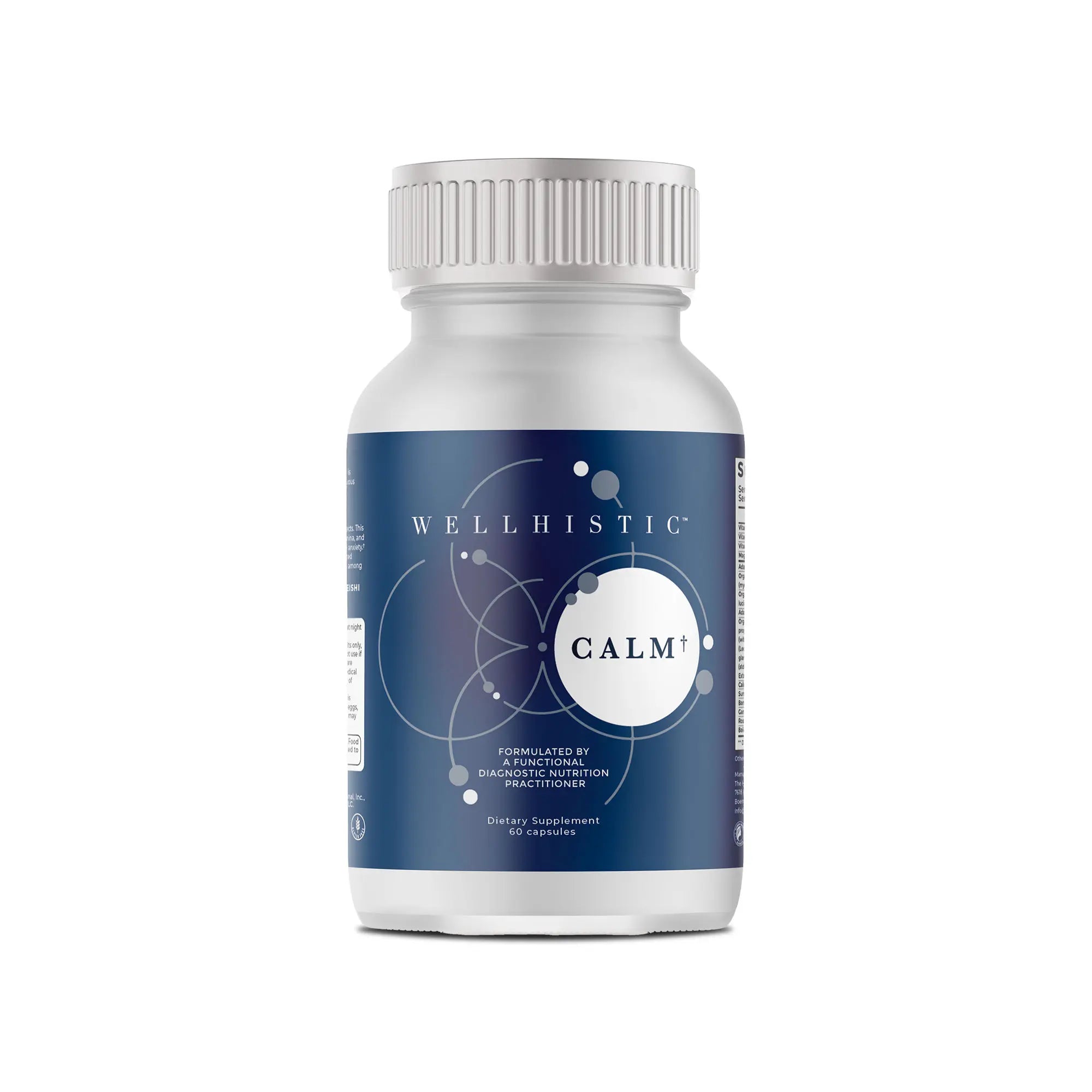
I didn't want calm that made me unable to function.
I wanted to feel:
Calm. Clear. Present.
That became part of the reason I created CALM.
Because sometimes the woman I'm thinking about isn't trying to go to bed.
She still has a day to live.
She has work.
Children.
Driving.
Decisions.
Life.
She wants nervous-system support without feeling like someone turned her brain off.
This one connects directly back to everything we've discussed.
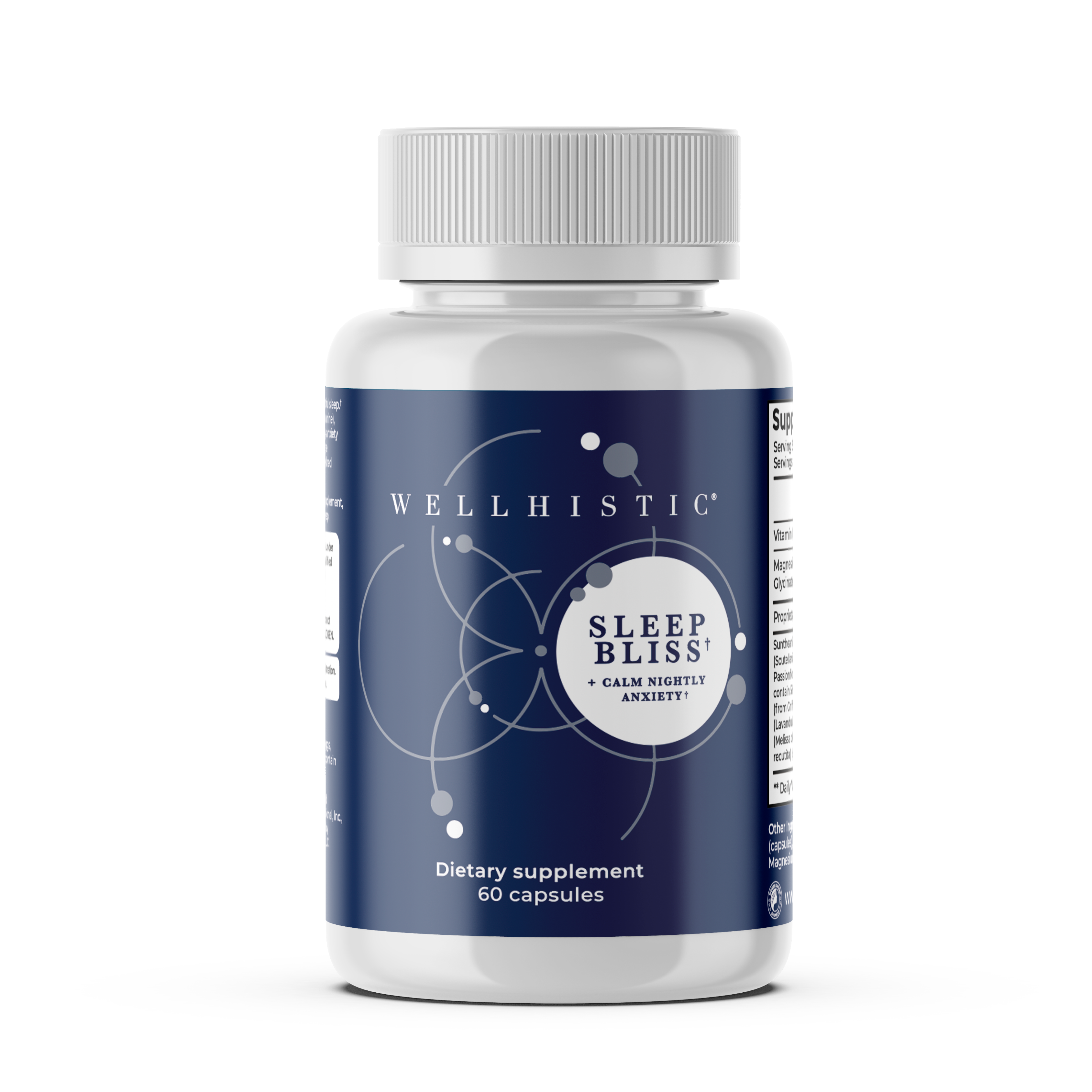
Sometimes tomorrow's energy problem begins tonight.
If you're sleeping poorly, tomorrow may bring more fatigue, more cravings, more caffeine and less stress tolerance.
Sleep Bliss was formulated around nighttime sleep support because sleep deserves its own place in this conversation. If melatonin leaves you groggy, you may also find Melatonin Alternatives: What to Take When Melatonin Leaves You Groggy helpful.
You cannot endlessly borrow energy from tomorrow.
Eventually, the body asks for repayment.
Then there's the other side.
The woman who wakes up and thinks:
I cannot do today.
I understand her.
I spent years using things like Coke because I needed something to make me function.
But what I eventually wanted was different.
I wanted support for energy and stress resilience without simply making an already overstimulated body feel even more wired.
That philosophy became part of BOOST.
No.
And I want to say that clearly.
More supplements are not automatically better.
Go back to your pattern.
What is actually happening?
This is why I don't want you buying supplements simply because a symptom list sounds familiar.
Understand the pattern first. Then choose support intentionally.
If you want to see how these formulas fit together from morning to night, read How to Build a Morning and Evening Routine.
Please don't let a wellness article convince you that every symptom is hormonal.
Persistent or severe fatigue deserves appropriate evaluation.
Heavy menstrual bleeding can contribute to iron deficiency and anemia. (PubMed)
Thyroid disorders can overlap with fatigue and other symptoms.
Sleep disorders, medications, mood disorders, nutrient deficiencies and other medical conditions can also contribute.
If you're experiencing severe weakness, fainting, dizziness, shortness of breath, unusually heavy bleeding or other concerning symptoms, seek appropriate medical care.
There is a difference between:
"My energy dips before my period."
and:
"My body is struggling."
Don't normalize the second.
Now I want you to turn this article into an experiment.
For two cycles, track:
Then add:
That's enough.
Then compare.
What happens before your period?
What happens after it?
What happens after a good night's sleep?
What happens after a terrible one?
What happens when you skip breakfast?
What happens on a high-stress day?
What happens when you need more caffeine?
What happens at 8 PM after you've been exhausted all afternoon?
You aren't trying to become your own endocrinologist.
You're learning your body's rhythm.
Start with the easiest, most obvious place to interrupt it. If sleep is poor, work on sleep. If you skip meals and crash every afternoon, look at food. If you rely on large amounts of caffeine, understand the exhaustion behind it before simply cutting it out.
Light is one of the strongest signals for your body's internal clock. Getting outdoor light after waking helps reinforce your circadian rhythm. It is not a cure for PMS, but it is a simple, free way to support healthier daytime alertness and nighttime sleep.
Not necessarily. Watch your caffeine timing and amount rather than fearing it. If you have PMS anxiety, insomnia before your period, a racing heart, afternoon crashes or feel wired but tired, late-day caffeine may be worth reducing.
Not every woman needs one. Comprehensive urine hormone testing can add information about reproductive hormones, metabolites and cortisol patterns in appropriate cases, but it does not replace blood testing for thyroid function, anemia or iron status. Testing should answer a specific question.
It depends on your pattern. Hormone & PMS Support is for when the menstrual cycle is the center of the pattern, CALM for stress and overstimulation without sedation, Sleep Bliss for nighttime sleep support and BOOST for daytime energy and stress resilience. You do not need all four.
If fatigue is persistent or severe, happens all month, or comes with heavy bleeding, fainting, dizziness, shortness of breath or significant mood changes, seek medical evaluation. Iron deficiency, thyroid disorders, sleep disorders and other conditions can contribute.
If you found this article because it feels like your PMS, stress, sleep and energy all fall apart together, I want you to leave with one idea:
Look for the loop.
Poor sleep can affect tomorrow's energy.
Low energy can increase your reliance on caffeine and quick-energy foods.
A crash can make an already stressful afternoon feel harder.
Stress and stimulation can make winding down more difficult.
Another bad night can make tomorrow harder.
And for some women, this entire cycle becomes dramatically more noticeable before menstruation.
At 16, I didn't know to look for any of this.
I was trying to survive the month.
By 30, I had started asking why.
By 34, I was already using the hormone formula I had developed with women in my practice—long before it ever had a beautiful Wellhistic bottle.
That progression taught me something I still believe deeply:
Don't just fight your symptoms. Learn their rhythm.
Your body is giving you information.
Morning.
Noon.
Afternoon.
Night.
Cycle after cycle.
Start listening to the pattern.
Because once you can see the pattern, you finally know where to begin.
TO YOUR INVISIBLE BATTLES AND UNSEEN STRENGTH.
Carola Le-Wriedt
Founder, Wellhistic & The Holistic Detox
These statements have not been evaluated by the Food and Drug Administration. These products are not intended to diagnose, treat, cure or prevent any disease.
This article is for educational purposes only and is not intended to diagnose, treat, cure or prevent disease. Supplements are not appropriate for everyone and may interact with medications or medical conditions. Pregnancy, breastfeeding, thyroid disease, hormone-sensitive conditions, prescription medication use, severe premenstrual mood symptoms, heavy menstrual bleeding and persistent fatigue or sleep problems deserve individualized professional guidance.

Carola Le-Wriedt, faced severe dysautonomia/POTS symptoms, leaving her bedridden and wheelchair-bound. Traditional Western medicine offered no clear solutions, so She embarked on a global quest for answers.


